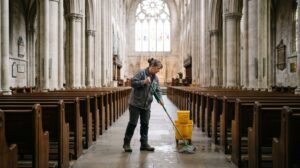
Most buildings get used steadily all week. A church sits nearly empty for days, then hosts several hundred people in a two-hour window, then empties again.
That pattern is the whole challenge. A cleaning plan copied from an office building spreads effort evenly across the week, which is exactly wrong for a space where 80% of the wear, mess, and germ transfer happens on one morning.
Church cleaning services work best when they are built around that spike — heavy reset after peak use, lighter touch in between, and real attention to the two or three rooms that carry far more risk than their square footage suggests.
Your Building Is Really Six Buildings
A sanctuary, a nursery, and a commercial kitchen have almost nothing in common except a shared roof and a shared budget. Pricing them as one flat square-footage number underserves the rooms that matter most.
| Space | What Makes It Different | What It Needs |
| Sanctuary or worship space | High seating density, soft surfaces everywhere, sensitive AV and instruments, often high ceilings | Upholstery and carpet care on a real schedule, careful dusting around equipment, periodic high dusting |
| Nursery and children’s ministry | Youngest and most vulnerable occupants, shared toys, diapering in many buildings | The highest-standard cleaning in the building — closer to childcare than to general commercial work |
| Fellowship hall and kitchen | Food preparation and service, heavy table and chair turnover | Food-contact sanitizers rather than general disinfectants, floor care that handles spills and grease |
| Restrooms | Extreme peak load in a short window, then idle | Deep reset after services, plus mid-service restocking on high-attendance days |
| Entryways and lobbies | Everyone arrives within the same twenty minutes, tracking in whatever is outside | Multi-stage matting, frequent attention during bad weather, fast response to wet floors |
| Offices and classrooms | Ordinary weekday use | Standard commercial cleaning on a normal schedule |
Pro Tip: If your current cleaning contract is one price for the whole building, ask for it broken out by space. The exercise alone usually reveals that the nursery is getting the same attention as a storage closet.
The Nursery Deserves More Attention Than It Gets
This is the single most common gap we see in church buildings, and it is worth being direct about.
Your nursery hosts infants and toddlers who mouth toys, crawl on floors, and have immune systems still under construction. Many church nurseries also handle diapering. That combination puts the room closer to a licensed childcare setting than to the rest of your building — even though it is only in use a few hours a week.
A few things that matter here:
- Cleaning and disinfecting are two separate steps. Soap and water first to remove soil, then an EPA-registered product to kill what remains. Disinfectant applied to a dirty surface binds to the soil and does very little.
- Mouthed toys need a food-contact sanitizer, not a disinfectant. Anything going into a child’s mouth should not be treated with a product meant for toilets.
- Hard, non-porous toys are easier to keep safe than plush ones. Fabric and plush items need laundering, which means they need a laundering schedule or they need to go.
- The touch zone is low. Toddlers work between the floor and about three feet, which is where chair rails, cubby edges, and the lower third of doors live.
Our guide to daycare cleaning requirements goes much deeper on this, and most of it transfers directly to a church nursery.
Pro Tip: Ask whoever cleans your nursery what contact time their disinfectant requires. If nobody knows, that is the highest-value fix available in your whole building.
Volunteers Can Do Real Work, Just Not All of It
Most churches run partly on volunteer labor, and that is a feature rather than a problem. The trick is matching tasks to who can reliably do them.
| Works Well With Volunteers | Better Handled Professionally |
| Resetting chairs and tables after services | Carpet extraction and upholstery cleaning |
| Collecting trash and recycling | Hard floor stripping, refinishing, and buffing |
| Tidying hymnals, cards, and seat backs | Restroom deep cleaning and disinfection |
| Wiping fellowship hall tables after coffee | Nursery disinfection to a documented standard |
| Light kitchen cleanup after events | High dusting, light fixtures, vents and returns |
| Restocking restroom supplies mid-service | Anything requiring equipment, chemicals, or training |
The division is not about capability. It is about consistency and liability. A volunteer team can reset a sanctuary beautifully every single week. Asking that same team to run a floor machine or maintain documented disinfection standards in the nursery puts people in a position they did not sign up for.
Pro Tip: Write down who owns what, and post it. Most church cleaning friction is not laziness — it is two groups each assuming the other handles the kitchen floor.
Older Buildings Need Gentler Methods
Plenty of churches occupy buildings far older than any commercial property a cleaning crew normally touches. Original wood, plaster, stone, stained glass, and historic finishes all respond badly to modern aggressive products.
The National Park Service publishes technical guidance on cleaning historic building materials that is worth knowing before anyone brings a pressure washer near masonry. A few general principles hold:
- Gentlest effective method first. Damage to historic material is usually permanent and often invisible until years later.
- Test in an inconspicuous spot. Always, on any surface nobody has cleaned before.
- Water is not automatically safe. Moisture driven into old masonry or plaster causes problems that take years to surface.
- Stained glass is specialist work. Leaded glass and painted glass are not a general cleaning task.
Pro Tip: If your building predates the 1960s, make a short list of surfaces that need specialist handling and give it to your cleaning vendor in writing. It protects both of you.
A Schedule Built Around the Week You Actually Have
Adjust to your attendance, your building, and what your volunteers cover.
| Timing | Tasks |
| During high-attendance services | Restroom checks and restocking, entryway attention in bad weather, spill response |
| Immediately after peak use | Full restroom reset, sanctuary tidy and chair reset, fellowship hall and kitchen cleanup, entryway floors, trash removal |
| Weekly | Nursery and children’s ministry cleaning and disinfection, all floors, offices and classrooms, detailed restroom work, high-touch hardware throughout |
| Monthly | Carpet extraction in high-traffic zones, upholstered seating spot work, vents and returns, window sills |
| Quarterly | Hard floor strip and refinish, full upholstery and carpet extraction, high dusting, light fixtures |
| Before major services | Extra pass ahead of holiday services, weddings, funerals, and anything that draws visitors who do not normally attend |
That last row earns its place. Holiday services and life events bring in people forming a first impression of your church, often on the building’s busiest and most strained day.
Pro Tip: Funerals and weddings rarely appear on a cleaning schedule because nobody knows when they are coming. Agree on a call-in rate with your vendor ahead of time so a Tuesday funeral does not turn into an awkward budget conversation.
Seven Questions to Ask Before You Hire
- Have you cleaned church buildings before, and can you describe the nursery standard you use? The nursery answer tells you most of what you need to know.
- Are your staff background checked, and can you document it? Non-negotiable in any building serving children.
- How do you separate tools between restrooms, the kitchen, and the nursery? Listen for color coding and a written system.
- Do you use a food-contact sanitizer on mouthed toys and food surfaces? If they only name a disinfectant, keep looking.
- Can you work around our service schedule and handle occasional short-notice events? Weddings and funerals do not plan around contracts.
- How would you handle our older finishes? If your building is historic, the answer should include testing and caution.
- Will you sign a checklist each visit? Useful when a committee asks what the church is paying for.
If you are weighing a vendor change more broadly, our guide to hiring local business cleaning services covers the general process.
How We Approach Church and Worship Facility Cleaning
Mountain Group is a commercial cleaning company serving churches and worship facilities alongside clinics, childcare centers, and commercial buildings. We treat the nursery and restrooms as the priority rooms, and we build the schedule around your service times rather than a generic weekly rotation.
Here is what we bring to a church account:
- Background-checked, trained staff. Every team member is background checked and trained on confidentiality and privacy before entering a client facility. In a building where children are present, this is the starting point.
- $5,000,000 commercial general liability coverage. We are bonded and insured. Ask any vendor for a certificate, particularly if your building is historic.
- A signed checklist on every visit. Our staff sign off on each visit, which gives your board or facilities committee a clear record of what the church is getting.
- Nursery standards borrowed from childcare and clinical work. The same discipline we apply to medical and clinic cleaning and childcare accounts — correct product for the surface, documented contact times, separated tools.
- Eco-friendly products as the default. We use natural products including vinegar-based solutions as a baseline, and ask before using anything more aggressive. Helpful in a building with older finishes and volunteer families around.
- Two-hour response and a 24-hour re-clean guarantee. If something is missed before a Sunday, we fix it.
- Month-to-month terms. No long contract, which matters when budgets run on an annual cycle and a committee has to approve them.
- 24/7/365 scheduling. Including the Saturday night turnaround and the unscheduled Tuesday funeral.
Offices, classrooms, and shared common areas fall under our janitorial cleaning services. Two related reads: our breakdown of restroom sanitation and restocking, which matters more in a church than almost anywhere given the peak load, and our piece on green janitorial services.
We serve the Minneapolis and St. Paul metro from our Edina office — see our service areas. Call (952) 683-0955 or request a free estimate, and we will walk your building, look at your service schedule, and show you where a volunteer team should hand off to a professional one. No obligation.
Frequently Asked Questions
How often should a church be cleaned?
Most churches need a full reset after their main weekly services, weekly attention to the nursery, floors, offices, and restrooms, and periodic deeper work on carpets, upholstery, and hard floors. Buildings that host weekday programs, preschools, or frequent events need more. The schedule should follow your actual use pattern rather than a flat weekly rotation.
What should church cleaning services include?
A complete scope covers the sanctuary or worship space, nursery and children’s areas, fellowship hall and kitchen, restrooms, entryways, offices, and classrooms — each with its own standard. The nursery and restrooms generally need the highest frequency and the most specific products.
Can volunteers handle church cleaning?
Volunteers handle reset and tidying work well: chairs, tables, trash, light kitchen cleanup, and restocking. Carpet extraction, floor refinishing, restroom deep cleaning, and nursery disinfection to a documented standard are better handled professionally, because they need equipment, training, and consistency week after week.
How should a church nursery be cleaned?
Clean first with soap and water to remove soil, then disinfect with an EPA-registered product, observing the contact time on the label. Toys children put in their mouths need a food-contact sanitizer rather than a disinfectant. Hard non-porous toys are easier to keep safe than plush ones, which need a laundering schedule.
How much do church cleaning services cost?
Cost depends on square footage, how many distinct spaces need separate standards, service frequency, whether a nursery or preschool operates in the building, and how much your volunteers cover. Mountain Group provides free on-site estimates and works month to month with no long-term contract.
Do historic church buildings need special cleaning?
Yes. Original wood, plaster, stone, and stained glass can be permanently damaged by aggressive products or pressure washing. The rule is gentlest effective method first, always tested in an inconspicuous area, and stained glass should be treated as specialist work rather than a general cleaning task.
Start With Your Busiest Two Hours
Think about the two hours each week when your building is fullest. Everything that matters most — restroom load, entryway traffic, nursery use, fellowship hall turnover — is concentrated there.
Build the plan around that window and the rest falls into place. Decide what gets reset immediately after, what your volunteers own, and what needs equipment and training. Then check the nursery, because that is where a small change in standard does the most good.